
Illustrations
-
1.Art history papers require reference illustrations; these can be photocopies, scans, or digital images.
-
2.Use illustrations to make specific points in your paper. Be sure to point out the specific details in the work that you want your reader to notice.
-
3.Illustrations should be gathered and presented in numerical order at the back of the paper. It is generally preferred that illustrations be on a separate page from the text of the paper or bibliography.
-
5.Figures should be numbered in the order the images are discussed in your paper. The first work you talk about is Figure 1. The second work mentioned in the text becomes Figure 2, etc.
-
6.References to illustrations should be made in the text of your paper in the following form: [Fig. 1] or {Fig. 2} where Fig. stands for Figure.
-
Example:
-
Michelangelo’s 1501-04 sculpture David has become synonymous with anatomical perfection. {Fig. 9} The historian Giorgio Vasari noted that the work “carried off the palm from all other statues, modern or ancient, Greek or Latin.” 8 This naturalism is in contrast to Michelangelo’s later work, The Bearded Slave of 1525-30. {Fig. 10} While both works have definition in the torso, The Bearded Slave only shows the most rudimentary definition in the face and legs.
-
You only need to include the figure notation the first time the artwork is mentioned. Note in the example above, you do not need to clarify Figure 10 a second time.
-
7.When preparing illustrations do not include printed material from the book you are copying. This appears sloppy. Include only the art work and typed label information.
-
8.Label information or captions should be typed and appear underneath the image. Include the following: figure #, artist’s name (or if unknown, culture), title (or description of work), date, medium and dimensions (if known), and location.
-
Sample caption:
-
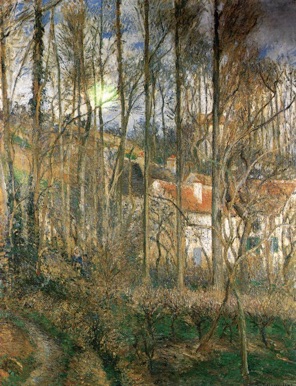
-
-
Fig. 1—Camille Pissarro, Orchard, Côte des Boeufs, at Pontoise, 1877. Oil on canvas, 45 1⁄4 x 34 1⁄2”, National Gallery, London